


Today we’re focusing on an important update related to the Home Health Proposed Rule. As noted in a recent Monday Minute, if the Proposed Rule is finalized as written, it will bring changes to the Value-Based Purchasing program beginning in 2026.
One of the most significant additions is a new measure called the “Medicare Spending Per Beneficiary Post-Acute Care Measure”. To help explain this change, Jennifer Osburn, one of our consultants here at Healthcare Provider Solutions, will walk us through the key components of how the Medicare Spending Per Beneficiary calculation is determined.
She’ll also be sharing additional insights and real-world examples during the upcoming HPS Free Webinar “Home Health Value-Based Purchasing 2025/2026”. In this webinar, Jennifer will take a deeper dive into how this calculation is applied and what it means for home health agencies moving forward.
The Medicare Spending Per Beneficiary Measure is designed to encourage agencies to strengthen care coordination within the patient-centered home health model. By tracking and calculating costs, this measure holds agencies accountable for the resources utilized throughout a patient’s care under their services.
The Medicare Spending per Beneficiary Measure is part of the IMPACT-Act and has been included in the Home Health Quality Reporting Program since 2017. It is also applied across other post-acute care settings, including Inpatient Rehabilitation Facilities (IRF), Long-Term Acute Care Hospitals (LTACH), and Skilled Nursing Facilities (SNF).
This measure evaluates cost and resource use, reflecting the expenses Medicare incurs for services provided to each beneficiary in post-acute care. It compares a provider’s results, in this case, home health agencies, against the national median for the same performance period. A key distinction is that, for home health, Medicare Spending per Beneficiary is calculated based on an episode of care, while in other post-acute settings it is measured by a stay.
If finalized as proposed, this measure will rely on two years of data. Each future performance year will be based on a single, non-overlapping year of data, allowing enough time to track and demonstrate quality improvement over time.
The calculation of this measure involves several steps. The numerator represents the Medicare Spending per Beneficiary Post-Acute Care amount for home health, which is the average risk-adjusted episode spending across all episodes for a provider, multiplied by the national average episode spending across all home health providers. To determine this figure, Medicare calculates the average ratio of standardized episode spending to expected episode spending, then multiplies that by the average episode spending level across all home health providers. The denominator is the episode-weighted national median of Medicare Spending per Beneficiary amounts across all home health providers.
First, it’s important to clarify what is meant by “episodes.” This refers to all Medicare Part A and Part B services provided within a defined episode window. That window begins on the first day of a home health claim, which also marks the start of the treatment period.
For this post-acute care measure, home health episodes are grouped into three types:
Standard Episode: Begins with a home health claim that does not involve a LUPA claim or a PEP adjustment.
LUPA Episode: Occurs when a home health claim meets the criteria for which a LUPA episode applies.
PEP Episode: A Partial Episode Payment (PEP) is applied when a home health claim qualifies for a PEP adjustment. This adjustment prorates payment for shortened care periods, which occur when a patient is discharged and then readmitted, either to the same agency or a different one, without a 60-day gap between the discharge and the subsequent admission.
When a claim qualifies for both a PEP and a LUPA adjustment, it will be categorized as a PEP episode type for the purposes of this measure calculation.
Medicare Spending per Beneficiary episodes are evaluated only against episodes of the same type. This means LUPA episodes are compared with other LUPA episodes, and PEP episodes are compared with other PEP episodes, rather than combining all episode types into a single comparison group.
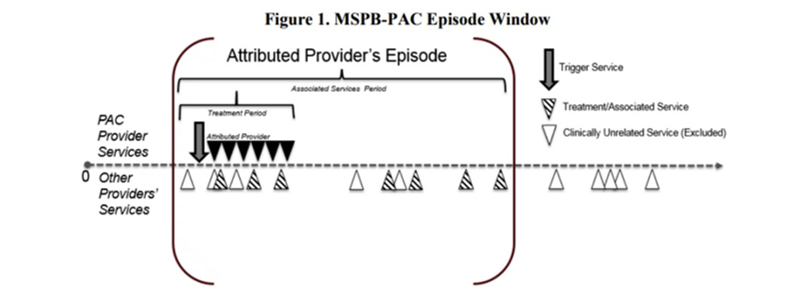
The episode window, as defined earlier, is shown within the parentheses or brackets in Figure 1. At the top, “Attributed Provider’s Episode” encompasses both the treatment period and all related services. The arrow indicates the first day of service on the claim, while the striped triangles represent associated treatments or services. The solid black triangles denote the home health services delivered by the agency.
Medicare Spending per Beneficiary is calculated for services billed by the agency during the treatment period and any associated services provided within the related service window. For instance, if a patient has a hospital stay while under the agency’s care, those costs are counted toward the agency’s overall spending.
Healthcare Provider Solutions stands ready to support you in any way with Value-Based Purchasing. For any assistance you might need, please reach out to us.
Finally, remember that the 2024 Annual Reports, including the adjustments impacting 2026 payments, were released a couple of weeks ago. We’ll be exploring them in more detail during our upcoming HPS Free Webinar “Home Health Value-Based Purchasing 2025/2026”.
Subscribe now to have our weekly Monday Minute with Melinda sent directly to your inbox. Click here to subscribe.